
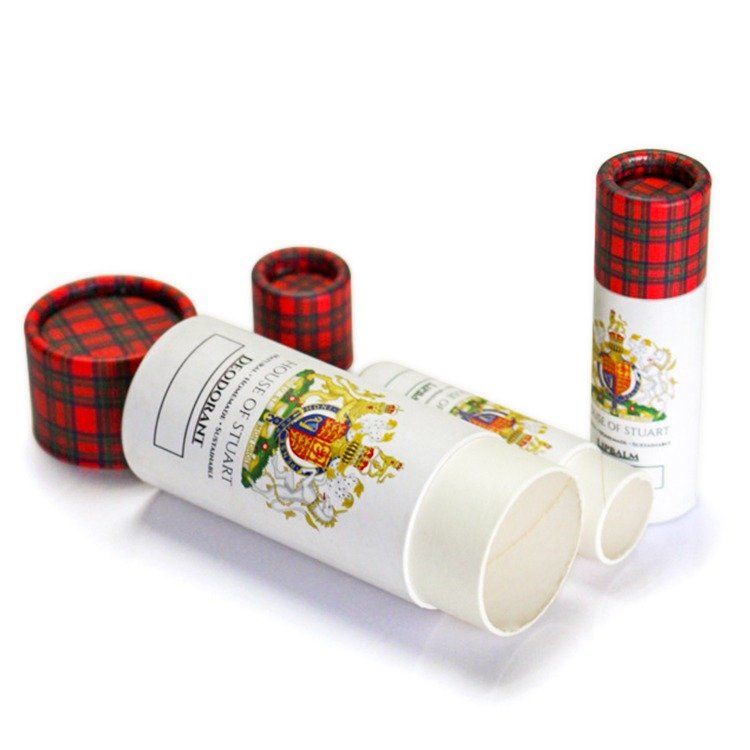
Customizing paper tube packaging takes 6 steps: define product specs, choose tube construction, select material and barrier, finalize artwork dieline, approve a pre-production sample, then run QC on a bulk order. Production typically runs 4–8 weeks from sample approval, and minimum order quantities usually start between 500 and 1,000 units.
Match the Tube to the Product Before You Match It to the Brand
Product requirements dictate packaging engineering, not the other way around. Wall thicknesses typically run 0.88mm to 1.2mm for standard lightweight items, and climb into the 1.5mm to 6.0mm range for heavy or luxury goods. That upper range is where most first-time buyers under-spec and then wonder why their candle jars arrive with cracked tubes.
Food contact adds a whole separate legal layer. In the US, materials have to meet FDA 21 CFR standards. In the EU, the Framework Regulation (EC) 1935/2004 applies. A plain paperboard tube is porous. It absorbs moisture, it wicks grease, and it will happily transfer whatever is in the printing ink straight into your product if nobody checked. Securing food-grade status means verifying that the board, the winding adhesives, the internal liners, and the outer printing inks all pass migration testing.
The other thing nobody budgets for: transit protection. Honeycomb inserts, thicker walls, a proper fitted base — those line items get cut in the quote stage and then show up again as a damage claim six weeks later.
| Product Type | Typical Wall Thickness | Closure / Liner Needs |
|---|---|---|
| Lightweight cosmetics | 0.88mm – 1.0mm | Friction-fit paper lid |
| Luxury heavy glass jar | 1.5mm – 2.0mm | Rolled edge, secure base |
| Loose leaf tea / Coffee | 1.0mm – 1.2mm | Food-grade barrier liner |
| Industrial shipping | 2.0mm – 6.0mm | Plastic/metal end caps |
Spiral vs. Convolute vs. Straight-Seam — Pick the Right Build
Spiral paper tubes are wound diagonally for strength, convolute tubes are rolled from a single sheet for a seamless finish, and straight-seam tubes have one vertical join for low-cost production. That’s the one-sentence version. The reality is messier.
Spiral winding overlaps plies of paperboard around a stationary mandrel at calculated angles. It’s fast, cheap, and you can get effectively any length you want off the line. The catch is the diagonal seam, which is visible on the interior and often on the exterior too. For a kraft tube in a candle set, nobody cares. For a $180 fragrance that lives on a department store shelf, it’s a dealbreaker.
Convolute winding pulls a continuous sheet straight onto the mandrel. No helical seam, smoother exterior, which is why high-end cosmetic and fragrance brands keep paying the upcharge for it.
Straight-seam tubes have one vertical join and lower structural integrity. Fine for a dry pasta sleeve. Not fine for anything you’d stack on a pallet.
| Construction Type | Strength Profile | Aesthetic Result | Cost |
|---|---|---|---|
| Spiral Wound | High crush resistance | Diagonal seam visible | Low |
| Convolute Wound | Moderate to High | Smooth, no diagonal seam | High |
| Straight-Seam | Low to Moderate | Single vertical seam | Low |
Paper Choice — Kraft, White, Black, and the Sustainability Fine Print
Paper tube outer wraps rely on heavy paper stock to accept printing without tearing, though exact weights vary by supplier and you should get those confirmed in writing before you approve a dieline.
Sustainability claims are where things get awkward. Regulators now care about documented material compliance, not marketing copy. Post-consumer recycled fiber ranks higher than post-industrial waste in most frameworks. For virgin paper, you’re choosing between two certifications:
- FSC (Forest Stewardship Council): Global reach, stricter social and environmental standards.
- SFI (Sustainable Forestry Initiative): North America-centric, built around regional forestry practices.
Both require your supplier to maintain an active Chain of Custody certificate, and the CoC number needs to show up on your invoice. If it isn’t on the invoice, it isn’t certified, no matter what the sales rep said on the call. I still ask for a scanned copy of the certificate itself on first orders, which is probably overkill, but I’ve been burned on this.
Printing Methods and When Each Is Worth the Upcharge
Offset lithography, digital printing, and hot foil stamping cover most paper tube decoration work. Each one has its own setup fees and volume breakpoints.
Offset gives you high resolution and tight Pantone matching. QC on offset runs means pulling samples and checking color drift with a spectro — you want Delta-E under 3.0 against the approved proof, and some beauty brands will spec under 2.0 in their contract. If you don’t know what Delta-E is before you sign that contract, you’re going to have a bad time at approval.
Digital printing skips the plate fees, so it wins on anything under 1,000 units. Past the 3,000-unit mark, offset’s per-unit cost has dropped far enough that digital stops making sense. Hot foil stamping needs a custom metal die, which means real tooling cost upfront, but the tactile result is something no printed finish can fake.
Barriers, Liners, and the Recyclability Trade-Off Nobody Warns You About
A paper tube is only fully recyclable if its liner is removable or made from the same fiber. PE and foil linings disqualify it from most curbside programs. Full stop.
Paperboard absorbs oils and moisture, so candles, coffees, and most cosmetics need a barrier. For decades the default was aluminum foil or polyethylene lamination. Those mixed-material constructions jam up standard repulping machinery, which is why most municipal facilities just divert them to landfill. Your “paper” tube goes to the same place as a plastic clamshell.
The regulatory pressure is only going one direction. On August 12, 2026, the EU Packaging and Packaging Waste Regulation enforced a strict cap on PFAS in food-contact packaging, with non-polymeric PFAS limited to 25 ppb. The practical effect for buyers is that mono-material structures — aqueous coatings, PLA films where commercial composting actually exists — are moving from “nice to have” to “the only thing your European distributor will accept.” PLA is a whole separate rabbit hole, because it only breaks down in industrial composting conditions, and your end customer’s municipal facility probably doesn’t run those. Worth reading the fine print before you put a compost logo on your box.
| Barrier Type | Best For | Recyclability Impact |
|---|---|---|
| Uncoated Kraft | Dry goods, apparel | 100% Curbside recyclable |
| Aluminum Foil | Coffee, loose tea | Disqualifies paper recycling |
| PE Lining | Oily cosmetics | Disqualifies paper recycling |
| Aqueous Coating | Short-term food contact | High repulpability |
Designing a Dieline That Actually Prints Right on a Curve
A dieline gives the factory exact cut, fold, and bleed instructions. Most factory rejections at the artwork stage come from designers who treated the tube like a flat box.
Standard EU and US specs call for a 3mm bleed on all sides. That extra artwork extends past the trim line so a slight shift on the cutter doesn’t leave a white sliver along the edge. Text, logos, and barcodes need to sit inside a safe zone 3mm to 5mm in from the trim. Anything closer to the lid crease starts to distort visually once it wraps around the curve.
Submit vector files (AI or PDF) so your text stays crisp at any scale. Raster graphics need to be at 300 DPI at final print dimensions, not scaled up from a 72 DPI web asset at the last minute.
The Pre-Production Sample — What to Actually Inspect
Never approve a paper tube design without physically testing a pre-production sample loaded with your actual product. Not a stand-in. Not a similar weight. The actual product.
- Drop Testing: ASTM D5276 is the standard reference for free-fall drop testing. Run it with the final insert, the final lid, and the exact production product weight.
- Friction Fit Checks: Paperboard breathes with ambient humidity. A lid that slides perfectly in a dry Shenzhen factory in February can swell shut or fall off in a Miami warehouse in July. Store the sample in a humid environment and re-check the fit before you sign off.
- Print Registration: Spectrophotometer, Delta-E under 3.0 between the approved proof and the production sample.
(Download our printable pre-production QC checklist here.)
MOQs, Lead Times, and the Real Cost Curve
Minimum order quantities for custom paper tubes usually start at 500 units overseas and 1,000 to 3,000 units domestically. Per-unit cost typically drops 40–60% as you move from 1,000 to 10,000 units.
For a standard 3×8 inch printed cylinder, ballpark pricing looks like this:
- 500 units: $2.80 per unit
- 1,000 units: $1.90 per unit
- 5,000 units: $1.20 per unit
Those numbers exclude tooling. Custom diameters, embossing, and custom foil dies all carry one-time setup fees that need to amortize across your run. The other thing to model before you commit: container utilization. Shipping a 20ft container full of assembled paper tubes is brutal on landed cost, because you’re paying ocean freight rates for the empty air inside each tube. Flat-pack is not an option here. This is the single biggest reason overseas pricing looks great on paper and lands worse in the P&L.
Supplier Vetting — Red Flags Before You Wire the Deposit
Look at payment structure and certification paper trail before you commit funds. The standard across most custom paper tube suppliers is 50% deposit upfront, 50% balance before shipping. A supplier demanding 100% upfront before tooling even starts is a severe financial risk and should end the conversation.
Request the ISO 9001 certification and the FSC Chain of Custody documents, and verify the certificates belong to the factory actually producing your tubes rather than a parent trading company. This matters more than people realize. A trading company holding the certs while subcontracting production to an unaudited facility is not the same as a certified factory.
Ask about the defect replacement policy. If they can’t define a defect rate tolerance in writing — AQL 1.0 for critical, 2.5 for major is the standard most buyers reference — walk away. Vague answers here always translate into vague answers when the shipment arrives with 8% misprints.
FAQ Section
1. What is the minimum order quantity for custom paper tubes?
Most overseas suppliers set minimums at 500 to 1,000 units. Domestic manufacturers typically require 1,000 to 3,000 units for fully custom printed runs.
2. How much does it cost to make custom paper tube packaging?
Prices range from $1.20 to over $3.00 per unit depending on size, volume, and finishes. An order of 5,000 units frequently cuts the per-unit cost by around 50% compared to a 500-unit run — the exact curve depends heavily on your diameter, your print method, and whether you need custom tooling for embossing or foil. Diameter is the sneaky one; a half-inch bump up on a 3-inch tube can shift your container math enough to erase the per-unit savings you thought you were getting at 5,000 units. Get a quote at two or three volume breakpoints before you commit to one.
3. Are custom paper tubes recyclable?
Only if they lack foil or PE liners. Mixed-material tubes get diverted to landfill.
4. How long does production take from design to delivery?
Expect 4 to 8 weeks total. Sampling runs 7 to 10 days, mass production 3 to 4 weeks, and ocean freight adds another 3 to 5 weeks on top.
5. Can paper tubes be used for food, cosmetics, or liquids?
Yes for dry foods, powders, and solid cosmetics when lined with FDA or EU-compliant barriers. No for raw liquids unless you add an internal glass or rigid plastic secondary container.